
If you’ve ever looked at a tent or sleeping bag and wondered what all the numbers mean, you’re not alone. From 3-season tents to waterproof ratings and sleeping bags marked with temperatures like -5°C or -10°C, camping equipment comes with quite a few specifications.
The good news is that they’re not difficult to understand once you know what they mean.
Here’s a simple explanation of the most common tent and sleeping bag ratings, so you can understand exactly what you’re looking at.
What Do Tent Season Ratings Mean?
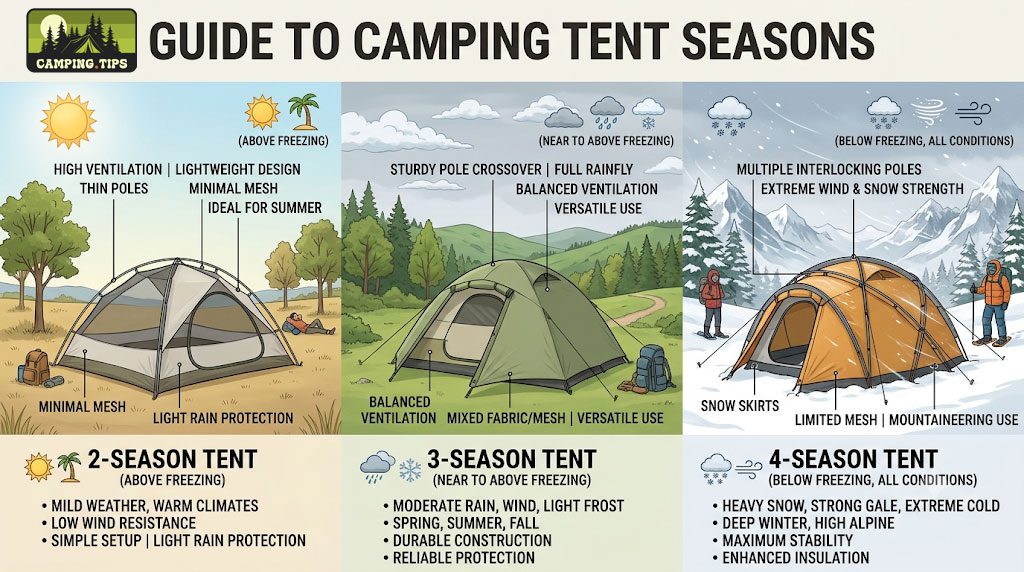
Tent season ratings describe the type of weather and conditions a tent is designed for. You’ll commonly see 2-season, 3-season and 4-season ratings.
2-season tents
These are generally designed for mild weather, warmer temperatures and relatively sheltered camping. They offer basic protection from light rain and wind but aren’t intended for more demanding conditions.
3-season tents
A 3-season tent is designed for spring, summer and autumn camping. It’s the most versatile option for typical camping trips, offering a balance of ventilation, weather protection and comfort camping.
4-season tents
These are designed for winter camping and more demanding conditions. They generally have stronger poles, sturdier construction and designs that handle strong winds and snow better.
Despite the name, a 4-season tent isn’t automatically the best choice for every camping trip. They’re often heavier and have less ventilation than 3-season tents.
It’s worth knowing that season ratings aren’t a universal standard, so the exact specifications can vary between manufacturers. Always check what a particular tent is designed to handle.
What Does the Waterproof Rating on a Tent Mean?
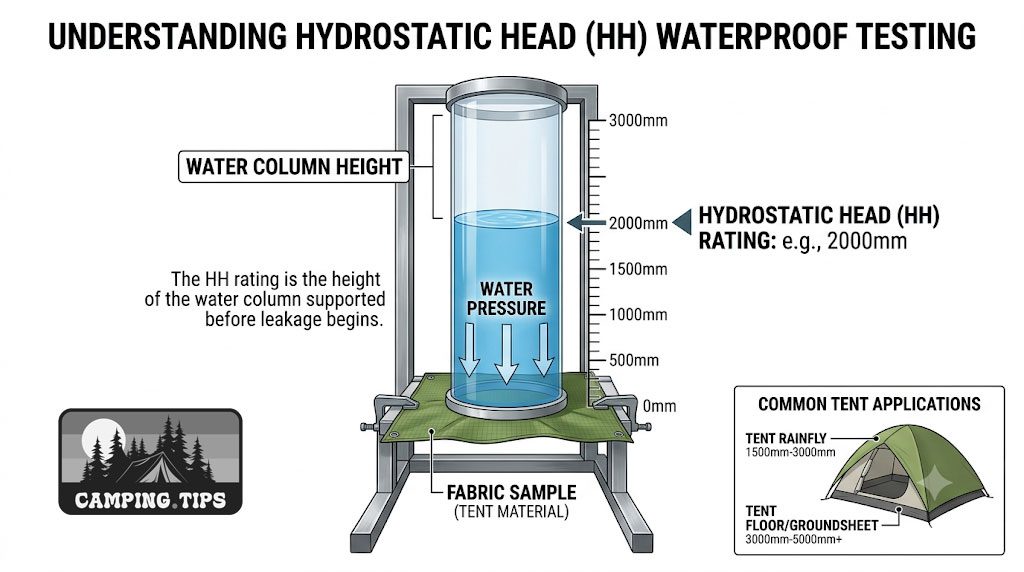
You’ll often see tent waterproof ratings written as 1,500 mm, 3,000 mm or even 5,000 mm.
These numbers refer to something called hydrostatic head (HH). It’s a measurement of how much water pressure a fabric can withstand before water starts passing through it.
The measurement is based on a column of water. For example, a fabric rated at 3,000 mm can withstand the pressure of a 3-metre column of water under the test conditions.
In simple terms, the higher the number, the greater the water pressure the material can withstand.
A few things to understand:
- 1,500 mm: A waterproof rating you’ll find on some tents designed for relatively mild conditions.
- 3,000 mm: A higher level of water pressure resistance, commonly found on tents designed for more demanding weather.
- 5,000 mm: Provides greater resistance to water pressure and is often used on tent floors and fabrics intended for wetter conditions.
These numbers aren’t a guarantee that a tent will remain completely dry in every situation. Construction, seams, zips, fabric condition and how the tent is pitched also matter.
You’ll also notice that the rainfly and tent floor sometimes have different waterproof ratings. This is normal. The floor can experience additional pressure from your weight, sleeping equipment and contact with wet ground.
What Do Sleeping Bag Temperature Ratings Mean?
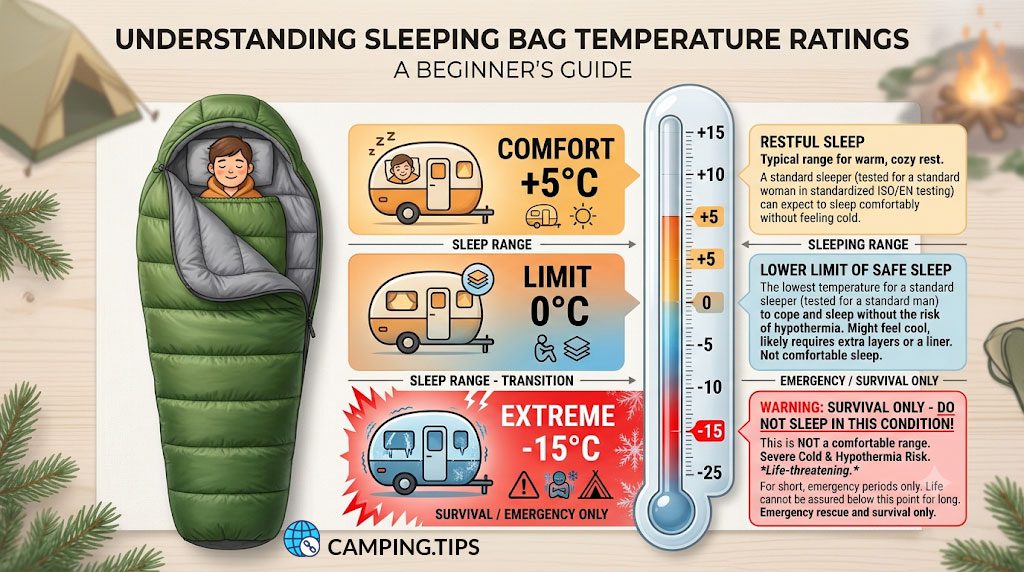
Sleeping bag temperature ratings are particularly useful, but it’s important to understand the difference between the numbers.
You might see a sleeping bag labelled with three temperatures, for example:
- Comfort: 5°C
- Limit: 0°C
- Extreme: -15°C
These are not three different temperatures at which the sleeping bag will feel equally comfortable.
Comfort rating
This is the temperature at which an average cold sleeper can sleep comfortably in the bag. If you tend to feel cold at night, this is generally the most useful rating to look at.
Limit rating
This is the lower temperature at which a warm sleeper can still sleep in the bag. It’s intended for people who naturally sleep warmer.
Extreme rating
This is a survival-related rating, not a temperature at which you should expect a comfortable night’s sleep. It describes an extreme test threshold and should never be used when choosing a sleeping bag for normal camping.
What Does ISO 23537 Mean on a Sleeping Bag?
You may also come across ISO 23537 or the older EN 13537 standard.
These refer to standardised laboratory tests used to measure sleeping bag temperature performance. They make it easier to compare sleeping bags from different manufacturers.
Not every sleeping bag carries a standardised rating, though. If a manufacturer simply advertises a sleeping bag as suitable for -10°C without clearly identifying a Comfort or Limit rating, it may be the manufacturer’s own estimate.
One last thing worth remembering: your sleeping pad also plays an important role in keeping you warm. The ground can draw heat away from your body, so even a well-rated sleeping bag may not feel as warm as expected if you’re using a poorly insulated sleeping pad.
A Quick Recap
Here’s what the most common camping ratings tell you:
| Rating | What it tells you |
|---|---|
| 2-season tent | Designed for mild camping conditions |
| 3-season tent | Designed for spring, summer and autumn |
| 4-season tent | Designed for winter and harsher conditions |
| Hydrostatic head (mm) | How much water pressure tent fabric can withstand |
| Sleeping bag Comfort | Temperature for comfortable sleep for a cold sleeper |
| Sleeping bag Limit | Lower temperature for a warm sleeper |
| Sleeping bag Extreme | Extreme survival-related test rating |
Understanding these ratings makes it much easier to know what your camping equipment is designed for. Once you know what the numbers mean, you can spend less time guessing and more time enjoying your next camping trip.


